

 Actividades, mazmorras y eventos
Por ahora esta guía solo está disponible en inglés. Los nombres de objetos, habilidades y monstruos se mantienen en inglés en todas partes, como en el juego.
Introduction
The Card Album is the card binder of your account: store your cards in it, follow your collection, and use them in the Trial Master, a card game where you duel players and NPCs on a 5 x 5 board, climb from the Bronze to the Diamond league, then fight for points in the ranked Players league.
To open it, move the mouse over the Menu button (the last round button, bottom right of the screen): the Menu panel opens above it. Click Trial Master in its Social row. The Card Album needs the DARO client.
 Menu > Social > Trial Master opens the Card Album
- 4 tabs: Binder, Collection, Trial Master, Leagues
- 20-40 cards in a deck, up to 10 decks
- 24 cells on a 5 x 5 board, the center is blocked
- 62 abilities, at most 2 per card
- 4 NPC leagues, from Bronze to Diamond, then the ranked Players league
 Binder Store your cards, filter them, take them out or slot them into your gear.
 Collection Every card that ever dropped for you, sorted into sets with reward steps.
 Trial Master Build your decks for the card game (20 to 40 cards).
 Leagues Your league, your reputation, the NPCs you can challenge, and the ranking of the Players league.
The Binder
The binder belongs to your account: all your characters share the same binder, and a stored card is no longer in your bag or storage. Right-click a card (or use the buttons under the card sheet) to act on it. A card that is not stored can still be stored from the same menu when it is in your bag.
 Take out of the binder One copy goes back to your bag.
 Slot into Puts the card straight from the binder into a free slot of an equipment you wear (the card must fit that equipment).
 Location Opens the page of the card in the Codex.
 Favorite Marks the card as a favorite in the binder.
 Store all Every card of your bag goes into the binder. Cards marked favorite in the bag, bound cards and rental cards stay in the bag.
 Take all out Every card of the binder goes back to your bag, until the bag is full.
Each binder page shows 3 x 3, 4 x 4, 5 x 5 or 10 x 10 cards. Show only the cards you own, or all the cards of the game, sort them by ID, name or stored copies, and narrow the list with the search box and the filters: Type, Location, Race, Element, Size and Effect. The card sheet on the right shows the card art, its effect, and its Trial Master values.
Card types

MonsterCards of normal monsters. Mini-boss Cards of boss monsters that are not MVPs.

BossShown in the window, but no card is sorted here for now (boss cards are in Mini-boss). MVP Cards of MVPs.
 Other Cards that no monster drops (event, quest, elite and other cards).
The counters at the bottom of the binder show how many different cards you have stored against all the cards of the game, the same count for each type, and how many cards your account still holds outside the binder (bags and storage).
The Collection
A card counts once it drops from a monster for one of your characters, solo or in a party (the owner of the drop). It stays counted for good, even if you sell it. Cards you buy or trade do not count.
Each set fills up as you find its cards, with reward steps at 25%, 50%, 75%, 100%. A step you reached shows Ready and a Receive the rewards button. For now every step says Reward to come: the set rewards are not set yet.
By card type
MonsterCardsBossCards- MVP Cards
By race
- Formless Race
- Undead Race
- Brute Race
- Plant Race
- Insect Race
- Fish Race
- Demon Race
- Demi-Human Race
AngelRaceDragonRace
By element
- Neutral Element
- Water Element
- Earth Element
- Fire Element
- Wind Element
PoisonElement- Holy Element
- Shadow Element
GhostElement- Undead Element
- 25% of the set
- 50% of the set
- 75% of the set
- 100% of the set
The Boss Cards set holds the Mini-boss cards.
Trial Master: the card game
Two players each bring a deck, take turns to place cards on a board of 24 cells, and take the cards of the other side. At the end, the one who owns the most cards wins.
Building a deck
- Open the Trial Master tab of the Card Album and click New deck (rename, duplicate or delete it there too). Up to 10 decks per account.
- Pick cards in the list: only cards stored in your binder can go in a deck, and each card once per deck.
- A deck needs 20 to 40 cards, and the total of its stars must not go over the limit of your league (Bronze 40, Silver 60, Gold 80, Diamond 100).
- The deck you chose last is your active deck: it is the one used against NPCs (you can switch it at the bottom of the Leagues tab), and offered first when you challenge a player or answer a challenge.
Only cards that come from a monster have Trial Master values (753 cards today). A card without values can sit in a deck, but it is left out when a duel starts. If you take a card out of the binder, the decks that use it can no longer be played until you store it again.
Card values
Every card has 4 values, one per side: top, left, right and bottom. In the album and on the board they are drawn as a diamond in the corner of the card.
- X The lowest rank: an attacking X never beats a number, an A or an S, and a defending X is always taken by them.
- 0 - 9 The higher number wins. Bonuses, penalties and tokens change these values, and a number can go above 9.
- A Worth 10, but beats any number, even 9 + 2. Only S beats it.
- S Worth 11, beats everything except another S.
Among the 753 cards with values there are 90 X, 41 A and 31 S values. Bonuses and tokens never move an X, an A or an S to another rank: they only decide between two values of the same rank (two X, two A or two S). If they are still equal, it is a tie.
Stars
The stars (1 to 8) come from the monster of the card. They set the points shared out over the 4 sides before any bonus, the turn from which you may play the card (a 5-star card from turn 5), and the cost of your deck.
- 1 star Monster level 1 to 20 12 points 64 cards
- 2 stars Monster level 21 to 40 14 points 100 cards
- 3 stars Monster level 41 to 60 16 points 127 cards
- 4 stars Monster level 61 to 80 18 points 111 cards
- 5 stars Monster level 81 and more 20 points 163 cards
- 6 stars Boss (not MVP) 22 points 71 cards
- 7 stars MVP below level 90 26 points 31 cards
- 8 stars MVP level 90 and more 28 points 86 cards
The points are shared out evenly over the 4 sides; what is left goes to top, then right, then left (14 points: top 4, left 3, right 4, bottom 3).
How the values are made
Starting from the shared-out points, the values are changed in this order. The numbers below are added to each side (top, left, right, bottom):
Element of the monster
- Fire top +1 left -1 right 0 bottom 0
- Water top -1 left 0 right +1 bottom 0
- Wind top 0 left 0 right -1 bottom +1
- Earth top 0 left +1 right 0 bottom -1
- Holy top +1 left 0 right 0 bottom -1
- Shadow top -1 left 0 right 0 bottom +1
Poisontop 0 left +1 right -1 bottom 0Ghosttop 0 left 0 right 0 bottom 0 (doubles the race modifier)- Undead top 0 left 0 right 0 bottom 0
- Neutral top 0 left -1 right +1 bottom 0
Race of the monster
- Formless top +1 left 0 right +1 bottom -1
- Brute top +1 left -1 right 0 bottom +1
- Undead top 0 left 0 right 0 bottom 0
Dragontop +1 left 0 right -1 bottom +1Angeltop -1 left +1 right +1 bottom 0- Demon top 0 left +1 right +1 bottom -1
- Demi-Human top 0 left -1 right +1 bottom +1
- Fish top 0 left 0 right 0 bottom 0
- Insect top +1 left +1 right -1 bottom 0
- Plant top -1 left +1 right 0 bottom +1
Size of the monster
- Small the two lowest values -1, the highest value +1
- Medium the two middle values +1, the lowest and the highest -1
- Large the highest value +2, the three others -1
Stats given by the card
The stat the card gives the most adds +1 on its two sides; when the card gives two stats or more, the one it gives the least takes -1 on its sides. A tie on the highest (or the lowest) changes nothing.
- STR top and left
- DEX top and right
- INT right and bottom
- VIT left and right
- AGI top and left
- LUK top and bottom
Abilities
The abilities come from the bonuses of the card, in the order of its script: a card keeps the first two that match an ability. No ability is on more than 40 cards: where an ability is too common, the cards with the weakest bonus get another ability of their own script instead, or lose it.
Each ability of the card has a cost: * the lowest value -1, ** the highest value -1, *** both, **** all four values -1 (see Abilities below). When two values are equal, the first one in the order top, left, right, bottom pays.
At the end, -1 or less becomes X, 10 becomes A and 11 or more becomes S.
Example: Poring Card
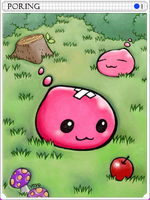
How the values of the  Poring Card are made, step by step. Its monster is a level 1 Water, Plant, Medium; the card gives LUK and Perfect Dodge.
- Base monster
 Poring level 1: 1 star, 12 points shared out top 3 left 3 right 3 bottom 3
- Element Water top 2 left 3 right 4 bottom 3
- Race Plant top 1 left 4 right 4 bottom 4
- Size Medium top 0 left 5 right 5 bottom 3
- Stats LUK is the highest: top and bottom +1 top 1 left 5 right 5 bottom 4
- Ability 1 Fortune (from LUK), cost *: lowest value -1 top 0 left 5 right 5 bottom 4
- Ability 2
Gold(from Perfect Dodge), cost **: highest value -1 (left comes before right) top 0 left 4 right 5 bottom 4
Result: top 0, left 4, right 5, bottom 4, 1 star, with the Fortune and Gold abilities.
Some cards
- Poring Card top 0 left 4 right 5 bottom 4 1 star Fortune
Gold 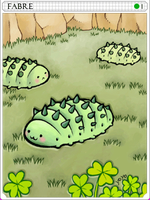 Fabre Card top 4 left 7 right 2 bottom X 1 star EnduranceResilience
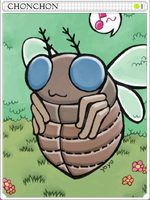 Chonchon Card top 4 left 5 right X bottom 5 1 star MobilityDodge
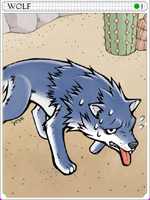 Wolf Card top 4 left 0 right 5 bottom 4 2 stars
FuryBerserk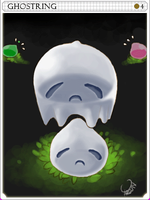 Ghostring Card top 7 left 7 right 7 bottom 1 6 stars Emblem
GhostRecovery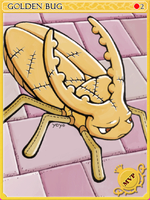 Golden Thief Bug Card top S left 4 right 5 bottom 5 7 stars Aegis
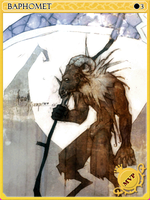 Baphomet Card top 4 left 6 right A bottom 5 7 stars Precision
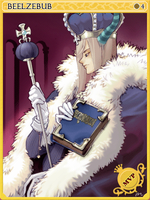 Berzebub Card top 6 left 8 right S bottom 3 8 stars Celerity
How a duel works
- Start. Both decks are shuffled and each player draws 5 cards. The player whose deck has the most stars plays first (same total: drawn at random). The challenger is Blue, the other side Red; against an NPC you are Blue.
- Initiative. If your deck holds cards with Initiative, you first choose I start (each of them adds 5 stars to your total) or Let them start (each removes 5 stars). No answer within 20 seconds counts as I start. An NPC always wants to start.
- Turns. A counter shows the turn (1, 2, 3...). In each turn each player makes one move: draw 1 card, then play one card on a free cell, or pass.
- Stars = turn. A card of N stars can be played from turn N on (1 star from turn 1, 8 stars from turn 8). Celerity: one turn earlier; Slow on the other side: one turn later; a
Goldcard can no longer be played from turn 8. With no card you may play, your move is passed for you. - SP. When you have SP, a +1 button shows next to your SP before you place a card: it spends 1 SP and the card comes in with a token +1 (2 with Magic). One SP per card. Both players start with 0 SP: SP come from Spirit, Spirit+ and Meditation cards.
- Attack. The card you play attacks the cards next to it that are not yours: its top value against the bottom value of the card above, its left against the right of the card on its left, and so on. Stronger: that card changes colour and is yours until it is taken back.
- Choices. Some abilities let you pick a cell after the attack (Rupture, Hex, Purify, Retreat, Expel, Mobility, Mimicry, Teleport): the cells you may pick are circled, and Skip passes the choice. With Chain you may then play a second card, or click End my move.
- Hand. More than 7 cards in hand at the end of your move: choose one to discard.
- Time. 30 seconds per move, then the move is passed (a choice is skipped, a discard takes your last card). Running out of time 3 times in a row loses the duel.
Tokens, element advantage and grey cards
- Tokens a token +1 adds 1 to all 4 values of its card, a token -1 takes 1 off. They add up with no maximum; a card can carry both kinds.
- Empty cells a token -1 put on an empty cell (Rupture,
 Paralysis) waits there: the next card played on that cell gets it.
- Moving a card that moves (Teleport, Mobility) keeps its tokens.
- X, A and S tokens never change their rank: they only decide between two X, two A or two S.
- Element advantage the attacking card gets +1 when the element of its monster does more than 100% damage to the element of the defending card (level 1 of the game table). Affinity makes it +2, Resonance doubles it. The defending card never gets it.
- Grey cards a card with Endurance that is beaten turns grey (neutral) instead of changing sides. It counts for nobody, and both players can attack and take it.
| Attacking element | Gets +1 against |
|---|---|
| Water | Fire, Undead |
| Earth | Wind, Poison |
| Fire | Earth, Undead |
| Wind | Water, Ghost |
Poison | Neutral, Holy |
| Holy | Shadow, Undead |
| Shadow | Holy, Ghost |
Ghost | Ghost, Undead |
| Undead | Neutral, Water, Earth, Fire, Wind |
| Neutral | nothing |
The board and captures
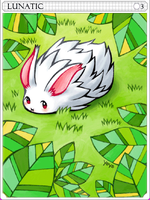 Red: Lunatic Card top 4 left X right 4 bottom 6 1 star FortuneBerserk
- Blue: Wolf Card top 4 left 0 right 5 bottom 4 2 stars
FuryBerserk - Blue, just taken: Poring Card top 0 left 4 right 5 bottom 4 1 star Fortune
Gold - Blue, just played: Fabre Card top 4 left 7 right 2 bottom X 1 star EnduranceResilience
- Blocked center
- Red: Chonchon Card top 4 left 5 right X bottom 5 1 star MobilityDodge
Example (no tokens on the board): Blue plays the  Fabre Card (top 4, left 7, right 2, bottom X, an Earth monster) in the gold cell. It attacks each enemy card next to it, side against facing side:
- Top: 4 against the bottom 6 of the
 Lunatic Card, which has
Berserk(-2 when defending): 4 against 4, a tie: it holds - Left: 7 against the right 5 of the Poring Card: taken, it turns blue
- Bottom: X against the top 4 of the
 Chonchon Card: an X never beats a number: it holds
- Higher wins the attacking value, with its bonuses and tokens, must be higher than the defending one
- Tie the defending card stays where it is, unless the attacker has Precision (and the defender has no Dodge)
- Ranks first X is below every number, A is above every number, S is above A; bonuses and tokens only decide between two values of the same rank
- Not yours the played card attacks the cards next to it that are not yours: the cards of the other side and the grey ones
- Only the played card attacks: cards already on the board do not attack again, except with Domination,
Counterand Vengeance
Abilities
A card has at most 2 abilities. In a duel, point at a card to see its abilities and what they do. Guard, Bane, Emblem, Race Emblem and Blazon keep their target, written after the name (for example Bane Demi-Human): an element, a race, a size, or All (every card). A few targets match no card in a duel (Boss, Normal, Player and some monster families): there the ability does nothing. The Cost is what the ability takes off the values of the card (see How the values are made); Cards is how many cards have it today. Abilities that say "may" can be skipped.
Attack and defense
| Ability | Cost | Effect | Cards |
|---|---|---|---|
Precision | * | Wins on a tie (when it attacks, not against Dodge) | 21 |
Dodge | * | Cancels the abilities of the card it fights | 33 |
Fury | * | +1 when attacking | 40 |
Vigilance | * | +1 when defending | 40 |
Resilience | * | Its lowest value gets +1 | 23 |
Balance | * | Its lowest value gets +2, its highest -1 | 36 |
Guard X | * | +2 when defending against this type | 102 |
Bane X | * | +2 when attacking this type | 83 |
Berserk | * | +2 when attacking, -2 when defending | 40 |
Explosion | ** | +3 when attacking, discarded after attacking | 9 |
Instability | ** | +2 when attacking; then 2 random cards of your hand are discarded | 10 |
Double | ** | +1 when attacking for each card it attacks | 2 |
Carnage | *** | +1 when attacking for each point you are behind | 17 |
Relentless | ** | +1 when attacking for each token -1 on the target | 9 |
Courage | * | +1 for each card of its colour next to it | 10 |
Protection | * | Your cards next to it get +1 when defending | 6 |
Finesse | * | The tokens +1 of the card it fights do not count | 11 |
Aegis | * | Tokens +1 from SP do not count against it | 22 |
Range | * | Fights the cards 2 cells away, not the ones next to it | 5 |
Elements and races
| Ability | Cost | Effect | Cards |
|---|---|---|---|
Emblem X | * | Your cards of this element get +2 when defending | 17 |
Race Emblem X | * | Your cards of this race get +2 when defending | 6 |
Blazon X | ** | Your cards of this element get +2 when attacking | 1 |
Affinity | * | Your cards of its element get +1; its element advantage is +2 | 16 |
Resonance | * | Its element advantage counts twice | 3 |
Tokens
| Ability | Cost | Effect | Cards |
|---|---|---|---|
Mystic | * | The next card you play gets a token +1 | 28 |
Defiance | * | The next card your opponent plays gets a token -1 | 33 |
Rupture | * | Puts a token -1 on up to 2 empty cells | 1 |
Hex | * | Puts a token -1 on a card in play | 6 |
Paralysis | * | Puts a token -1 on the 4 cells around it | 3 |
Resistance | * | Ignores its tokens -1 | 29 |
Purify | * | Removes all tokens -1 from one of your cards | 5 |
Recovery | ** | Loses a token -1 at the start of each turn | 12 |
Fortune | * | Comes in with 0 to 2 tokens +1 (at random) | 22 |
Victory | * | If it flips a card, it gets a token +1 | 16 |
Thorns | * | When flipped, the attacker gets a token -1 | 27 |
Erosion | ** | Removes a token +1 from each opponent card next to it | 1 |
Vampirism | *** | Takes the tokens +1 of the opponent cards next to it | 5 |
Magic | * | 1 SP spent on it gives 2 tokens +1 | 40 |
SP and cards in hand
| Ability | Cost | Effect | Cards |
|---|---|---|---|
Spirit | * | You gain 1 SP | 9 |
Spirit+ | *** | You gain 2 SP | 26 |
Meditation | * | While you control it, each draw from a card gives you 1 SP | 7 |
Draw | * | You draw a card | 13 |
Focus | * | If it flips a card, you draw a card | 25 |
Loot | * | Your opponent discards a random card | 26 |
Plunder | ** | Your opponent discards a random card, you take it | 1 |
Turns and placing
| Ability | Cost | Effect | Cards |
|---|---|---|---|
Initiative | * | +/- 5 stars to decide who starts (you choose at the start) | 6 |
Celerity | * | Can be played 1 turn earlier | 13 |
Chain | *** | After it, you may play another card (its stars count half, rounded down; only one more card) | 12 |
Slow | * | While you control it, your opponent plays cards 1 turn later | 0 (no card has it yet) |
Intrusion | *** | Can be played on the centre cell | 3 |
Gold | ** | Worth 2 points at the end; cannot be played from turn 8 | 15 |
Moving cards
| Ability | Cost | Effect | Cards |
|---|---|---|---|
Teleport | *** | After attacking, can be moved elsewhere (a free cell, or stay) | 2 |
Retreat | * | May bring one of your cards in play back to the hand of the player who played it | 14 |
Expel | **** | May send an opponent card in play back to the hand of the player who played it; then the Expel card gets 2 tokens -1 | 1 |
Mobility | * | May swap places with an allied card next to it | 23 |
Flips
| Ability | Cost | Effect | Cards |
|---|---|---|---|
Domination | ** | The cards it flips attack in turn (and the cards they flip, and so on) | 16 |
Counter | ** | An opponent card played next to it is attacked first; if it loses, it does not attack | 7 |
Vengeance | *** | When flipped, it strikes back at the card that flipped it | 7 |
Sacrifice | * | Is flipped instead of an allied card next to it | 6 |
Endurance | * | When beaten, becomes neutral (grey) instead of changing sides | 23 |
Tenacity | ** | Once flipped twice, all its values become S | 9 |
Mimicry | ** | Copies the abilities of a card next to it | 1 |
End of the duel
The duel ends when:
- The board is full.
- Both hands are empty.
- Both players passed 3 turns in a row.
- A player conceded.
- A player left the duel.
- A player ran out of time 3 times.
"Both hands are empty" means that both hands and both draw piles are empty. A turn that is passed for you because you have no card you may play does not count as one of the 3 passed turns.
Then each side counts its cards on the board: 1 point per card of its colour, 2 points for a Gold card; grey cards count for nobody. More points wins, the same is a draw. Conceding, leaving the map, dying or disconnecting is a loss; closing the duel window asks you to click again, then concedes. After the duel you can see the board again, close it or ask for a Rematch against the same NPC.
Challenging someone
Against a player
- Right-click the player and choose Challenge to Trial Master (the Party / Friends and Guild windows have the same line on their members).
- Both must be on the same map, at most 14 cells apart.
- Choose your deck and click Send the challenge. When you are both in the Players league, you choose Duel or Ranked duel instead.
- The other player has 20 seconds to Accept (with one of their decks), Refuse, or Refuse for 1 h (then you cannot challenge them for one hour).
Against an NPC
- Open the Leagues tab of the Card Album, pick an NPC of your league (or a lower one), choose your deck at the bottom and click Challenge.
- The duel starts where you are: no need to walk to the NPC.
- NPCs of a league above yours refuse to play.
To duel you must be alive, out of combat, with full HP and SP, and not trading, vending, buying, in a chat room, using your storage or already in a duel. Out of combat means 10 seconds without attacking, casting a skill or being hit. Your deck must be valid for your league: 20 to 40 cards, not too many stars, all its cards still in the binder.
Leagues
- Bronze
40 stars at most in your deck
20 NPCs, their cards up to 3 stars
They sometimes play at random (35% of their moves).
- Silver
60 stars at most in your deck
20 NPCs, their cards up to 5 stars
They rarely play at random (10% of their moves) and start to protect their weak sides.
- Gold
80 stars at most in your deck
20 NPCs, their cards up to 7 stars
They always play their best move and protect their weak sides.
- Diamond
100 stars at most in your deck
20 NPCs, their cards up to 8 stars
They play their best move and also think about your answer.
- Start every account starts in Bronze; the league belongs to the account
- Reputation against a member of your league (player or NPC): win +1, loss -1, draw 0; it never goes below 0
- Other leagues a duel against someone of another league changes nothing
- Rank up 10 wins against 10 different members of your league and 10 reputation: you move up to the next league, and your reputation starts again at 0
- Diamond is the last NPC league
The Leagues tab shows your league, your two progress bars (wins against different members, reputation), your duels played and won, and for each league its NPCs with their place, the stars of their deck, their style and a check mark once you beat them. Each NPC always plays the same deck of 20 cards, built around a theme. Duels give no reward for now.
The Players league (ranked)
- Who every account that reached the Silver league against the NPCs; you join with 100 points
- Challenge right-click a player, Challenge to Trial Master, then Ranked duel (both of you must be in the Players league)
- Win the winner takes 10% of the loser's points (rounded down, at least 1); a loser with no points left gives nothing, and no points are ever created
- Draw nothing changes; conceding, leaving or disconnecting is a loss
- Once a day one ranked duel a day against the same player
- Alternate beating the player you beat in your last ranked win gives no points (and they lose none)
- Reputation a ranked duel also counts for your league reputation, like any duel
In the Leagues tab, the Players row shows your points, your rank, your ranked duels and wins, and the top 20 players.
The NPCs of each league
- Bronze
Tipsy(Porings),Butcher(Brutes),Bakery Dealer(Small cards),Tool Dealer(Formless),Flower Lady(Plants),Vegetable Fruit Gardener(Earth),Bottle Dealer(Goldand Fortune),Little Kid(Insects),Charlie(Wind),Poyette(SP),Innkeeper(Vigilance),Bartender(Fury),Hostess(Draw),Book Seller(Mystic),Fish Exchanger(Fish),Shoes Seller(Celerity),Gift Merchant(Loot),Item Collector(tokens -1),PecoBoy(Pecos and birds),Merchant(Balanced) - Silver
Mining Master(Earth),Cooking Master(Fire),Brewing Master(Poison),Fishing Master(Water),Learning Master(Focus and Draw),Hunting Master(Brutes),Camping Master(Plants),Tools Refiner(Bane),Fulerr(Fury),Christopher(Demi-Humans),Repairman(Guard),Jeweler(Gold),Card Broker(Chain),Elite Card Smith(Large cards),Granny Georgette(Recovery),Mikuru(SP),Essence Synthesizer(tokens -1),Treasure Hunter(Loot),Map Technician(Range),Daily Provider(Insects) - Gold
Captain(Fish),Kafra(Demi-Humans),Clarice(Holy),Alexia Kurtis(Domination),Olaf(Dragons),Khalia(Guard),Guardian(Protection),Mister Jakk(Undead),Royal Messenger(Draw),Diplomat Gael(Mimicry),Attendance Curator(Gold),Marry(Angels),Event Manager(Mobility),Hugel Squire(Brutes),Representative(Emblems),Casino Manager(Fortune),Intoxx(Poison),Hishigi(Shadow),Yang Xia(Endurance),Malebolgia(Demons) - Diamond
Nava(Balanced),Hatori Henzo(Fury),Payle Itaki(Magic),Nazar(Guard),Adelaide(Holy),Uriel(Babel, Angels),Gabriel(Babel, Bane),Brigitte(Pets),Sir Varleen(Dragons),Sir Alfred(Demi-Humans),Lady Mielle(Ghost),Krane The WoE Ranker(Chain),Brone the MvP Ranker(Bosses),Migal the Instance Ranker(Undead),Ganbantein(SP),Old Druid(Rivendel, Plants),Fairy Scholar(Rivendel, Insects),Titania(Wind),Royal Gospel(Holy),Whitesmith(Fire)
The theme of each NPC's deck is in brackets. All of them are in Midgard (town or buildings), unless another place is written. Deck styles shown in the Leagues tab: Attack, Balanced, Bane, Chain, Defense, Draw, Gold, Magic.